

I Built an Agent That Writes My Substack Notes for a Week in 20 Minutes
I know, I roll my eyes at "agents" too. But hear me out...

I know. The word “agent” makes me cautious too. Every AI company is slapping it on everything right now, and most of what people call an agent is just a chatbot with a marketing budget.
So let me be specific about what mine actually is: an automated workflow. It pulls data, reads files, runs scripts, and writes output to a folder. Four steps chained together so I don’t have to run them manually every Sunday.
Three months ago I shared the Notes prompt that changed how I show up on Substack. It went viral. 132 likes, hundreds of saves, and a flood of DMs from writers who started using it the same week.
That prompt still works. But I stopped using it the way I shared it.
Somewhere between February and now, I turned that prompt into something bigger. I gave it memory. I connected it to my analytics. I let it learn from what actually performs instead of guessing from a formula sheet. And I wrapped it in this agent (read: automated workflow 🙃) that handles everything from pulling last week’s data to scheduling next week’s Notes in about 20 minutes on a Sunday morning.

Why the Old Prompt Stopped Being Enough
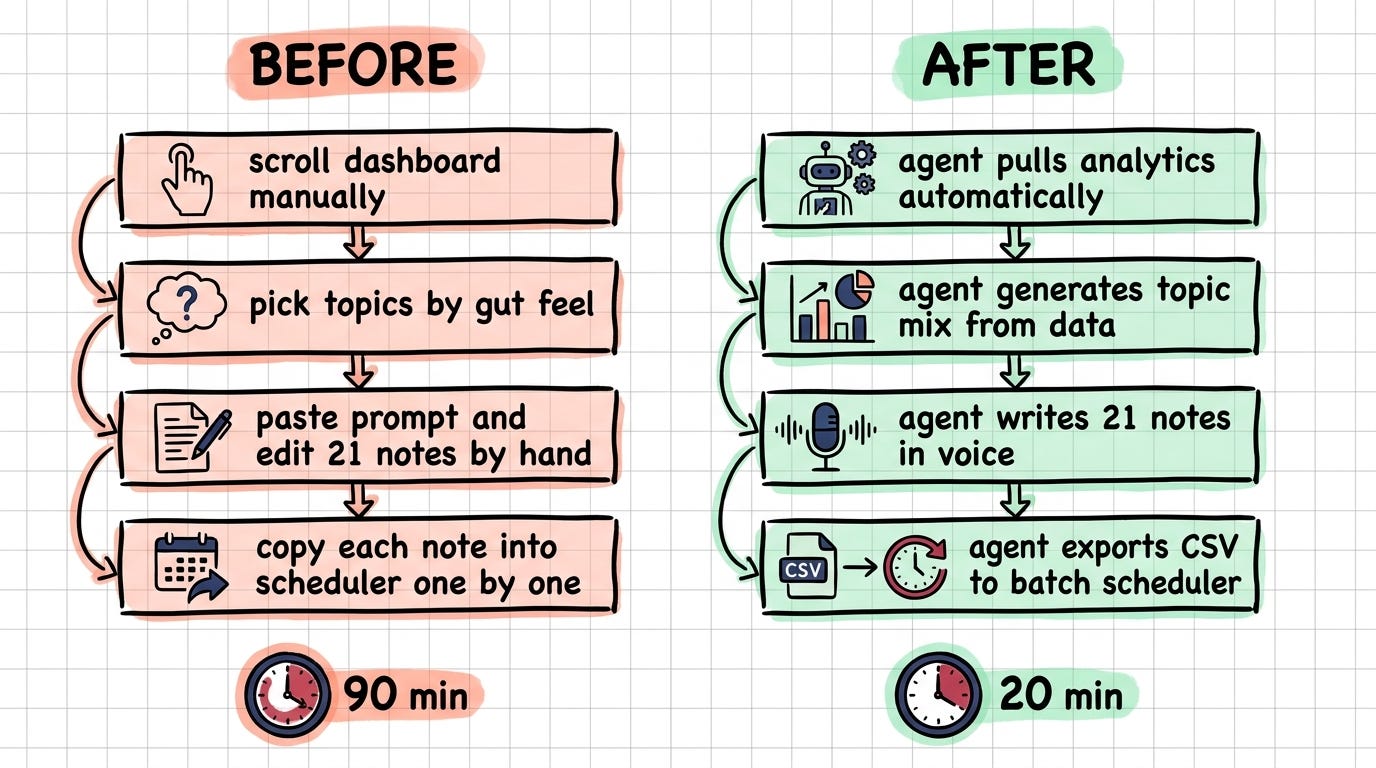
My Notes prompt from February did one thing well: it followed viral formulas and wrote in my voice. But every week I was still doing four manual steps around it.
Step 1: I’d scroll through my Substack dashboard, mentally noting which Notes performed and which didn’t.
Step 2: I’d figure out what topics to cover next week based on gut feel and whatever was trending in my niche.
Step 3: I’d paste the prompt into Claude, wait, then edit 21 Notes by hand.
Step 4: I’d copy each Note into my scheduler one at a time.
That was still 90 minutes. Some weeks closer to two hours if I second-guessed the topic mix. For someone running two newsletters, a consulting business, and a coaching program, two hours of Notes production every Sunday felt like a tax I kept paying.
The prompt was doing 30% of the work. I was still doing the other 70% manually.
What Changed: the Agent Layer
An agent is a prompt that can do things. It reads files, runs scripts, pulls data from a browser, writes output to specific folders, and chains those steps together without you orchestrating each one. You describe the outcome. The agent figures out the execution.
My Notes agent has four steps, and it runs all of them in sequence from a single command.
Step 1: Pull Performance Data
The agent opens my Substack dashboard through Puppeteer (a browser automation tool connected to Claude Code via MCP). It reads the last 7 days of Notes: likes, comments, restacks, and subscriber conversions for each one.
Then it summarizes the patterns. Which formats pulled the most engagement. Which topics converted subscribers. Which Notes flopped.
This is the part most creators skip entirely. They publish, move on, and base next week’s strategy on memory. Memory is unreliable. The data isn’t.
One insight from a recent pull: a Note with 34 likes converted more subscribers than one with 266 likes. The short, specific, actionable Note outperformed the one that went semi-viral. I would never have caught that by scrolling casually. The agent caught it in 8 seconds.
Step 2: Generate the Topic Mix
Based on the performance summary, the agent proposes 21 topics for the coming week. Three Notes per day, seven days. It pulls from my content pillars (AI tools, prompting, creator workflows, building with AI) and weights the mix toward whatever performed best last week.
It also cross-references my recent articles. If I published a piece about creator AI stacks on Tuesday, the agent pulls the most surprising number, the most actionable tactic, and the core contrarian insight from that article and turns each into a Note. Repurposing happens automatically.
I review the topic list, swap maybe 2 or 3, and approve.
Step 3: Write 21 Notes in My Voice
This is where the original viral prompt lives, but upgraded. The agent reads my voice profile (sentence rhythm, transition style, banned phrases, 18 AI writing fingerprints to avoid) and my Notes formula library (7 proven formats ranked by engagement). It writes all 21 Notes in one pass.
The mix is intentional. At least 2 micro-Notes under 100 characters. At least 3 in the 100 to 250 range. A few longer ones in the 400 to 600 range. No two consecutive Notes use the same format. This variety pattern came directly from the performance data: accounts that alternate between ultra-short and medium-length Notes get 40% more profile visits than those posting the same format every time.
Every Note hits the checklist before output: zero rhetorical questions, zero generic motivation, all numbers specific and exact, no hashtags, no emojis in the text. The agent enforces rules I used to enforce manually by re-reading everything twice.
Step 4: Export and Schedule
The agent writes all 21 Notes to a CSV file with columns for content, date, and time. I upload that CSV to my batch scheduler (a tool I built that lets you schedule Substack Notes in bulk, since Substack only supports scheduling one at a time through the interface).
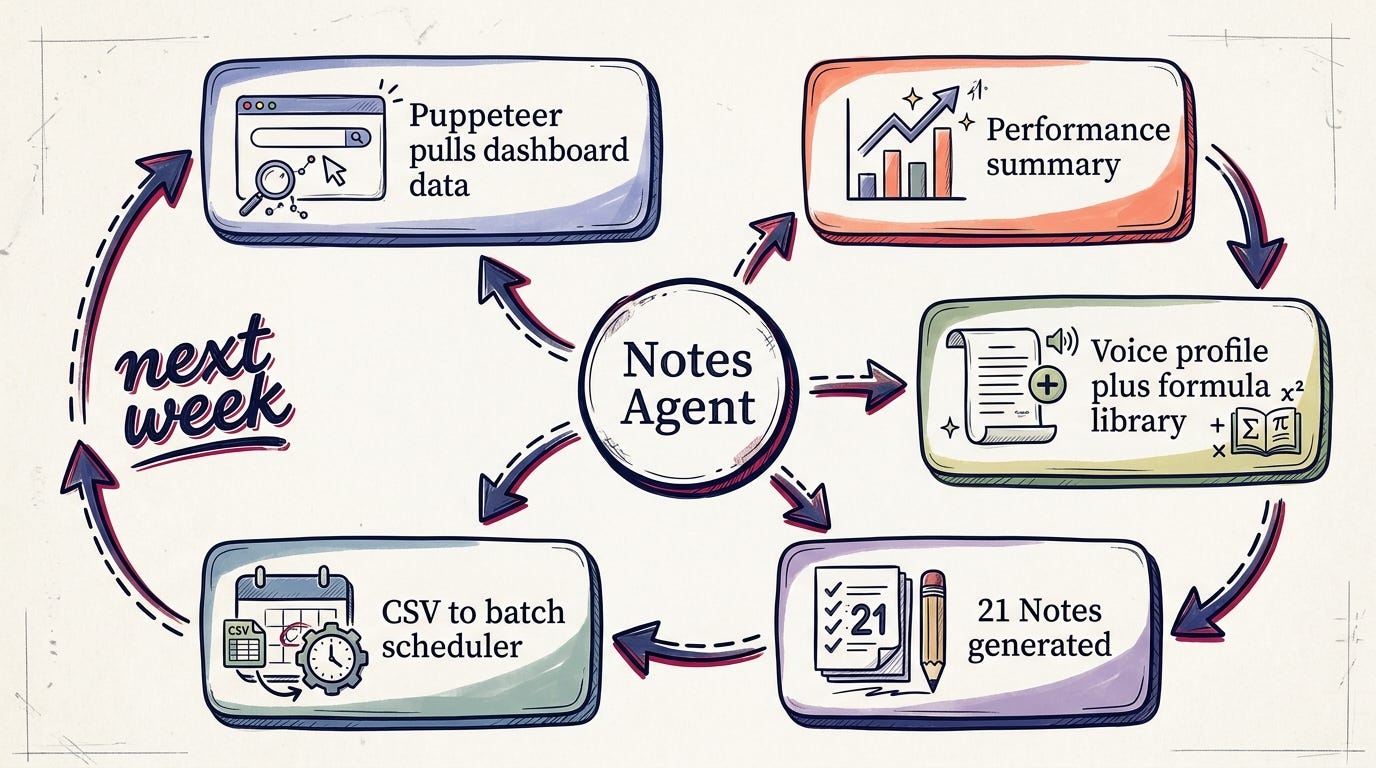
Sunday morning to Sunday upload: 20 minutes. Sometimes 25 if I rewrite a few Notes by hand. The rest of the week, Notes post automatically at the times the data says my audience is most active.
If you’re reading this thinking “I want someone to build this kind of system with me, for my business,” that’s exactly what the AI Business Builder is. Four weeks, fully 1:1. Your own agents running.
The Prompt (Copy-Paste Ready)
Here’s the core prompt I feed the agent. This is the instruction set for Step 3, the actual Note generation. Steps 1, 2, and 4 are handled by the agent’s tool chain (Puppeteer for data, scripts for CSV export).
You are writing Substack Notes for [YOUR NEWSLETTER NAME] by [YOUR NAME].

ABOUT THIS NEWSLETTER:
[1-2 sentences describing your newsletter's focus and who reads it. Example: "This newsletter helps creators and solopreneurs implement AI tools and build online businesses. Readers are AI-curious but action-oriented, they want workflows not theory."]

VOICE RULES:
- Write like you're texting a smart friend who runs a business
- Use "you" and "I" freely
- Mix sentence lengths. Short punchy lines between longer explanations.
- Use specific numbers. 884 not "almost 900." 23 not "over 20."
- [Add 3-5 phrases you use naturally. Mine: "Here's exactly what I do," "The difference is everything," "This is where most people stop."]

Sentence Structure (no AI language):
No "It's not X, it's Y" / "Not because X, but because Y" negative parallelism
No "Not X. Not Y. Just Z." dramatic countdowns
No fake "From X to Y" ranges where X and Y aren't on a real scale
No self-posed rhetorical questions answered immediately ("The result? Devastating.")
No filler transitions ("It's worth noting" / "Importantly" / "Notably")
No tricolon abuse (three parallel constructions back to back)
No anaphora abuse (repeating the same sentence opening multiple times)
No tacking "-ing" phrases for shallow analysis ("highlighting its importance", "reflecting broader trends")

Tone:
No grandiose stakes inflation (everything is civilization-changing)
No invented compound labels ("the supervision paradox", "the acceleration trap")
No "Here's the kicker" false suspense transitions
No "Think of it as..." patronizing analogies
No "The truth is simple" asserting obviousness instead of proving it
No "Experts argue..." vague attributions without named sources

Word Choice & Formatting:
No ornate words where simple ones work ("tapestry", "landscape", "paradigm", "synergy", "ecosystem")
No excessive short punchy fragments as standalone paragraphs
No listicles disguised as prose ("The first step is... The second is...")
No unicode arrows or smart quotes

NOTE FORMATS (use at least 5 of these, never repeat the same format twice in a row):

1. Imperative Command: Open with a direct command. Specific steps. Action close.
   Example: "Grab a notebook. Write exactly what you want your business to look like in 12 months..."

2. Bold Claim + Reality Check: Start with a contrarian statement. Expand on what really happens.
   Example: "You don't become consistent by planning harder. You become consistent by removing the decisions that drain you before you start..."

3. Definitional Framework: Define 2-3 levels of the same concept. Reveal the deeper truth.
   Example: "A tool is something you try once. A workflow is something you run weekly. A system is something that runs without you..."

4. The Confession: What went wrong. The messy middle with real numbers. The unexpected outcome.
   Example: "I spent 4 hours last Tuesday writing 6 Notes. Three of them got under 10 likes. The one I almost deleted got 266..."

5. Quick Tip: "Quick tip:" opener, one specific action, done.
   Example: "Quick tip: schedule your Notes at 7:30 AM, 12:15 PM, and 6:45 PM. Those three windows get 2x the impressions of random posting times on my account."

6. Ultra-Short Truth: 1-2 sentences max. A universal observation that hits immediately.
   Example: "The creator posting 3x a day with a system will always outperform the one posting once a week with 'inspiration.'"

7. Data Truth: Lead with a surprising number. Explain why it matters. Challenge an assumption.
   Example: "34 likes, 12 new subscribers. 266 likes, 3 new subscribers. Virality and conversion are not the same metric."

STRUCTURE:
- Generate exactly 21 Notes for 7 days (3 per day)
- No two consecutive Notes use the same format
- Length distribution:
  - 2+ micro Notes (under 100 characters)
  - 3+ short Notes (100-250 characters)
  - 10+ medium Notes (250-450 characters)
  - Up to 4 full Notes (450-600 characters)

TOPIC MIX:
- Cover these content pillars across the week: [LIST YOUR 3-5 MAIN TOPICS. Mine: AI tools, prompting/strategy, creator workflows, building with AI]
- Weight toward whatever you performed best in last week. Here's my data: [PASTE YOUR LAST WEEK'S TOP 3 NOTES AND THEIR LIKE/RESTACK COUNTS]
- Include 3-5 Notes that repurpose insights from this article: [PASTE YOUR MOST RECENT ARTICLE OR KEY PARAGRAPHS]

OUTPUT:
For each Note, include: the Note text, which format you used, and the character count. Group them by day (Day 1 through Day 7, 3 per day).
How to make this yours in 15 minutes:
Fill in the brackets. The voice rules and banned list matter most. Read 10 of your published posts and pull out phrases you actually use, and phrases you’d never write. That contrast is what makes AI output sound like you instead of like everyone else. The Note formats above work across niches. I’ve tested all 7 on my account. Use them as-is until you have enough data to know which ones your audience responds to, then cut the weak ones and double down.
The performance data section is optional for your first batch. Skip it, generate 21 Notes, post them for a week, then come back and paste your top performers into the prompt before generating the next batch. That’s how the feedback loop starts.
The System Diagram
Here’s how all four steps connect:
Puppeteer → Performance Summary → Topic Mix → Notes Generation (Voice Profile + Formula Library) → CSV → Batch Scheduler → Published Notes
Each arrow is automated. The only human touchpoints are reviewing the topic list (Step 2) and reviewing the final Notes (Step 3). Everything else runs.
The performance data from this week feeds back into next week’s generation. The agent gets better every cycle because it’s learning from real engagement numbers, not static formulas.
What This Actually Means for Your Business
I share the technical workflow because the request in my DMs is always “show me how.” But the workflow is the smallest part of what’s happening here.
The bigger shift: I freed up 90 minutes every Sunday and redirected that time toward the work that actually grows revenue. Coaching calls. Building offers. Closing clients.
Last week I spent 20 minutes on Notes production and 3 hours on a coaching session that paid $1,200. The week before, I used the freed-up time to restructure my AI Business Builder program from a group format to fully 1:1, which made it dramatically more valuable for the people who sign up.
That restructuring happened because I had the space to think about it. When your content production eats your entire Sunday, you never get around to the strategic work that compounds.
Every creator I work with in my coaching program hits this wall. They’re spending 60% of their time producing content and 40% on the business that content is supposed to support. The ratio should be flipped. AI agents are how you flip it.
What You Get in the AI Business Builder
I sold a spot two days ago. One spot left for June.
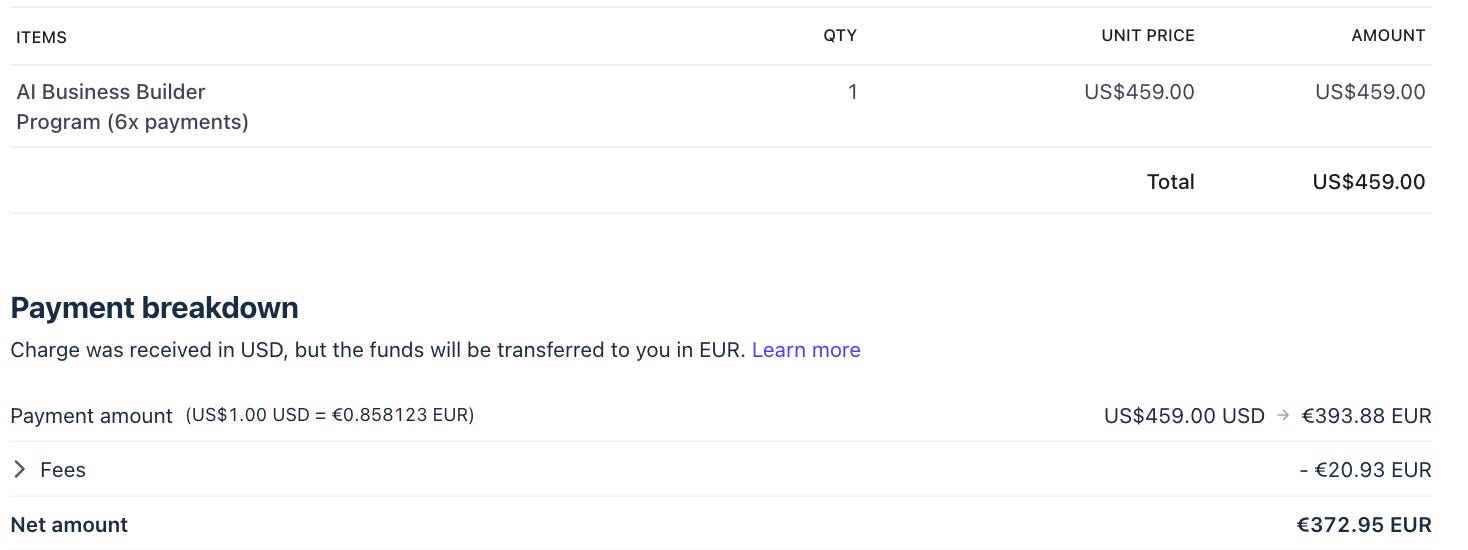
Here’s what happens in four weeks of private 1:1 calls:
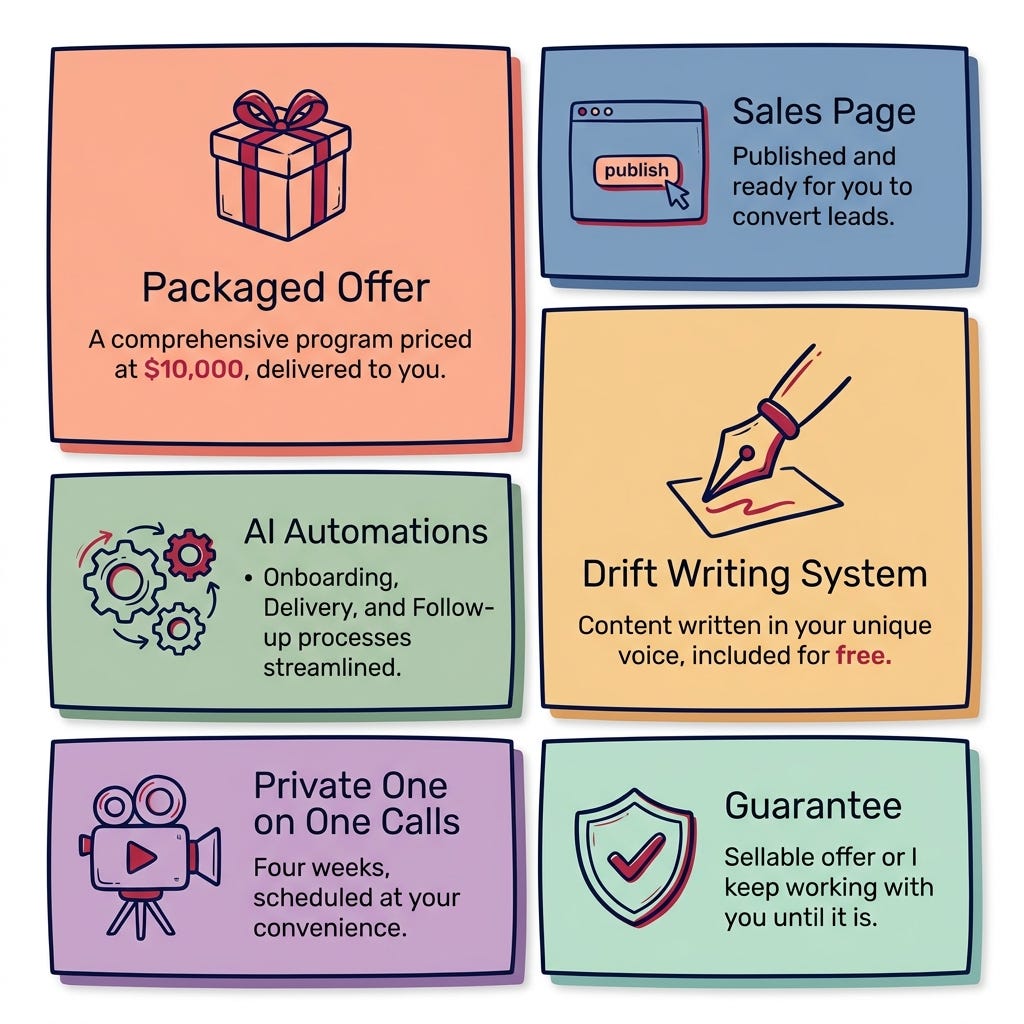
You walk out with a packaged offer you can describe in one sentence and price at $10K, because we stress-test your positioning live until it holds up. A sales page that’s published and ready to send to prospects the day we finish. 2 to 3 AI automations handling your onboarding, delivery, or follow-up, so taking on a second client doesn’t mean doubling your hours. And Drift, my AI writing system ($1,399 value), generating content in your voice whenever you need to promote your offer.
My client, Julia M. landed a $10K client within a month of finishing the program with me. One new client of her pays for the program four times over.
My guarantee: do the work, and if you don’t walk out with a sellable offer and working AI systems, I’ll keep working with you until you do. No extra charge.
Start Building This Week
You don’t need my exact stack to get the core benefit. Here’s the minimum version:
If you have Claude Code: Create a CLAUDE.md file with your voice rules, your banned phrases, and your Notes format preferences. Ask Claude to generate 7 Notes for the week. Review, edit, post. That’s your v1. Add the performance data loop when you’re ready.
If you don’t have Claude Code: Take the prompt above, strip out the file references, paste your voice rules directly into the prompt, and use it in any Claude conversation. You lose the automation layer but keep the voice matching and format variety.
If you want the full system built for you: That’s the AI Business Builder. I sold a spot on Sunday. One left for June. We build your automations together, on your business, producing real output before week four. → Save your spot
🚀 Work with me
AIBergStudio is my AI consultancy. I work with business owners, offices and companies in to figure out where AI fits and build the first system that actually runs.
We start with a free call. I look at your business, find the highest-impact workflow, and tell you exactly what I’d do. If it makes sense to work together, we go from there.
A little about me
I live for helping people figure out AI without the hype. When I’m not building workflows, I’m adventuring with my rescue dog Mambo, who has zero interest in AI but very strong opinions about what we eat.

P.s. I publish every Wednesday. Subscribe and it lands in your inbox. Free.
Claudia Faith holds a Master of Science in AI. She's a VC-backed founder who's worked with Fortune Global 500 companies to deploy AI where it actually matters. As a Fractional Chief AI Officer, she handles strategy and implementation, and offers 1:1 coaching for business owners who don't want to be the last in their industry to figure this out. If you want help thinking through your own AI strategy, start here.
okay this is actually interesting! because if it really reduces friction without killing your voice, that’s the only time AI writing agents are really useful
AI has changed my life for the better and I use it strategically and I sell custom AI products, so it’s awesome and I love it… what I don’t love is the algorithms that create the need to have automated workflows to pump out content that was once intended for actual human connection. I find myself simultaneously thankful that there are tools for ‘organic marketing’ and bored/uninspired by all of the AI created content that’s posing as real people just so we can keep up with the daily demand from these platforms. Anyway - sorry, I guess that was kind of a vent - and it’s not directed at you. This is an awesome approach and I genuinely love your content, even though I know you use AI to generate it 😜 I just hate the marketing and I’m trying not to hate it…