

Your Audience Is Starting to Hate AI Content. You Should Care.
Most AI advice tells you what to create. This is about what to create before you create anything.

I sat down this morning with nothing. No topic, no angle. A paid subscriber had asked me to write about connecting AI to my publishing tools. Technically interesting, but I could feel most of you clicking away by paragraph three.
So instead of forcing it, I asked my AI to research. Not to write. To research.
15 minutes later, it had scanned Reddit, X, and 30+ web sources and surfaced a pattern I would have missed: the anti-AI backlash in marketing is accelerating fast. And almost nobody in the AI creator space is talking about it.
That research became this article.

The Backlash Is Real
CNN called 2026 “the year of 100% human marketing.”
“Slop” was Merriam-Webster’s 2025 word of the year.
Adweek reported 65% of marketing jobs may not survive AI.
Plus, I scanned what’s trending on Substack. The top posts this month: “10 Claude Prompts That Replace a $500/hour Consultant” (1,300 likes) and “How to run your AI agents while you sleep” (1,700 likes).
Most AI marketing content is genuinely bad. Not because AI can’t write well, but because most people use it the laziest way possible: paste topic, get 800 words, publish, repeat. Readers notice.
The 3 Layers A Lot of People Skip
Most people jump straight to “write me a blog post.” That’s layer zero. And it shows.
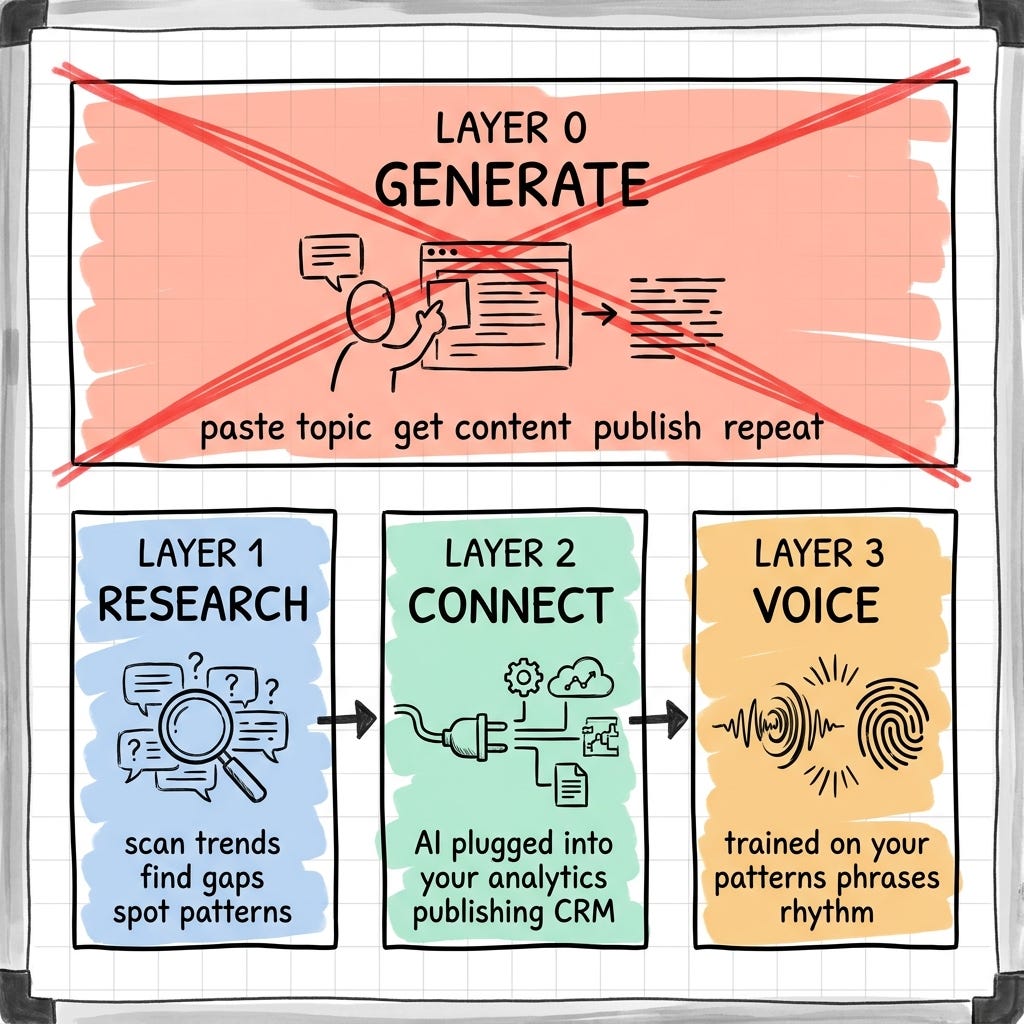
Layer 1: Research
Before you write anything, you need to know what’s worth writing about. Most people guess, or copy what competitors posted last week.
AI can scan thousands of conversations across platforms in minutes. This morning, I found a genuine gap and got an article I’m excited about. Instead of another “5 AI tools” list.
Try this now: Open Perplexity or Grok and search “what are people complaining about in [your industry] this week?” That’s layer 1 in 30 seconds.
Layer 2: Connection
MCP (Model Context Protocol) gives AI direct access to your tools. Instead of copying data from your analytics into a chat window, your AI reads it directly.
I use Claude Code with a Puppeteer MCP server. That's how I browsed Substack's trending pages earlier today without leaving my workflow. My AI opened a browser, navigated to Substack, scrolled through posts, and pulled engagement numbers. All from the same conversation where I was writing this article.
Try this now: Search “[your analytics platform] MCP server” and see if one exists. You might be surprised.
Layer 3: Voice
Default AI writing sounds like AI. Readers can sense it.
I built a voice profile for this newsletter: my opening patterns, sentence rhythm, phrases I use, and phrases I never use. When AI writes with this profile, it sounds like me, not like a language model performing “helpful newsletter writer.”
Try this now: Take your 3 best-performing posts. Let AI analyse it - how you opened each one, one phrase you used in all three, and one thing you’d never say. That’s the start of your voice profile.
What This Means
The 65% who won’t survive are at layer zero. The 35% are building AI into their actual operation: research before writing, tools connected for context, voice profiles that sound human.
The backlash will keep growing. But the people using AI this way won’t be part of that conversation. Because their audience won’t be able to tell.
Get my full system
The free articles show you what I built. Premium gives you everything behind it.
See what’s in it for you when you go premium.
🚀 Work with me
AIBergStudio is my AI consultancy. I work with business owners, offices and companies in to figure out where AI fits and build the first system that actually runs.
We start with a free call. I look at your business, find the highest-impact workflow, and tell you exactly what I’d do. If it makes sense to work together, we go from there.
A little about me
I live for helping people figure out AI without the hype. When I’m not building workflows, I’m adventuring with my rescue dog Mambo, who has zero interest in AI but very strong opinions about what we eat.

P.s. I publish every Wednesday. Subscribe and it lands in your inbox. Free.
Claudia Faith holds a Master of Science in AI. She's a VC-backed founder who's worked with Forbes 100 companies to deploy AI where it actually matters. As a Fractional Chief AI Officer, she handles strategy and implementation, and offers 1:1 coaching for business owners who don't want to be the last in their industry to figure this out. If you want help thinking through your own AI strategy, start here.
Hi Claudia, the layer doing the actual work in your stack might not be the voice profile. It might be whatever decides which sentence to keep when the model offers three. A profile gives you fingerprint-level consistency, like rhythm, openings, phrases used and avoided. But when readers can't tell with the 35%, I'd guess the imitation hasn't gotten better. Someone is still choosing, line by line, against a sense of what this particular piece needs to do.
That choosing is probably something we do naturally enough that it doesn't come up; which is why it's missing from most stacks, including the way I just described yours. Still worth holding open the question of whether we sometimes accept what the voice profile gives us a little too easily, because it already sounds right actually doing that choosing, or whether the voice profile is doing more of the work than we'd want to admit.
I would be wary of the third one beyond the marketing angle, but the other two sound amazing from my perspective. I'm just an engineer, and setting up a test and gather data are things that are significant in terms of the amount of time it takes. Having AI help do the heavy lifting of foraging for data is a great application, but the curation and internalization of it would still be on the person. Digests and summaries are great for heuristics and efficiencies, but when it comes to absorption, there's no substitute for doing that part of the work.
Thanks for sharing your thoughts on this! Marketing is a foreign concept that's been fascinating to learn about.